
If you initially came in because you were in pain, and we successfully got you out of pain, why would you still need chiropractic care? This is a common question I hear from patients, and it’s an understandable one.

The answer is simple but powerful: less than 10% of your nervous system’s function is related to pain. That’s right, less than 10%.

More than 90% of your nervous system’s job is focused on supplying proper nerve signals to your organs, coordinating posture, balance, movement, and helping your body orient itself to gravity and the world around you. Living without pain is important, and something I absolutely want for you. It is not however my primary objective as a Doctor of Chiropractic.

My primary objective is to help you maintain a healthy, properly functioning nervous system so your body can exist in a true state of health. A well-functioning nervous system allows your body to better adapt to stress and change, both internal and external. That includes pain relief, but it also extends to immune function, organ function, stress resilience, and maintaining or improving your overall functional ability.

If you know me, you know I enjoy a good saying. One of my favorites is: “A fence at the top of the hill is better than an ambulance at the bottom.”

The Iceberg Analogy
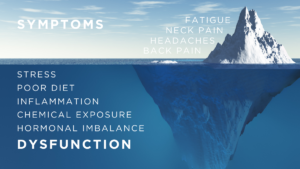


Once acute pain improves and we establish a new baseline, it allows us to shift care toward addressing deeper, underlying health challenges. I often explain this using the iceberg analogy. Pain is the small portion of the iceberg visible above the water. Dysfunction is the massive portion hidden beneath the surface. Many people focus only on what they can see and feel, while ignoring what’s happening underneath. That’s a disservice to their long-term health.

When care isn’t consistent, we lose the opportunity to truly address those deeper issues. Over time, things tend to resurface, often leading to frustration and the feeling of “why does this keep coming back?” To be blunt, most people do a better job maintaining their vehicles than they do their own bodies. We understand the importance of oil changes, tire rotations, and routine maintenance to keep a car running well. Yet many people neglect healthy eating, regular exercise, and ongoing chiropractic care, the very things that keep their bodies on the road.

Because the nervous system controls and coordinates every other system in the human body, it’s often referred to as the master system. Chiropractic adjustments help restore and enhance the nervous system’s ability to do its job effectively. That’s why regular chiropractic care is so critical, not just for pain relief, but for overall health and optimal function.

So the next time you ask yourself, “Do I really need to get adjusted if I’m not in pain?”
The answer is yes.

Remember: less than 10% of your nervous system is about pain. Over 90% is about how you function. If you want to function at your fullest, maintain regular chiropractic care.

Dr. Joe Heinecke, DC
Mountain Valley Chiropractic
(970) 314-9244

© 2025 Mountain Valley Chiropractic. All rights reserved.

Check out these studies from PubMed supporting maintenance chiropractic care:

https://pubmed.ncbi.nlm.nih.gov/31832142/

https://pubmed.ncbi.nlm.nih.gov/30208070/

When Backpacks Equal Back Pain

by Dr. Heinecke, Mountain Valley Chiropractic

As the school year approaches here in Grand Junction, I see a familiar pattern every fall—kids are gearing up for a new routine, and their bodies are about to be put to the test. I immediately think about backpack posture.

Earlier mornings. Heavier schedules. And in the shuffle, we sometimes skip small but important things—like making sure the kids eat a real breakfast or checking whether their backpack still fits them well.

I’ve also noticed (both in my patients and in my own home) that many kids shoot up in height over the summer. Suddenly, their clothes don’t fit, their appetites change, and as parents, we’re trying to keep up. In our house, we’ve navigated the “I don’t like that” stage plenty of times. Even with the best efforts, kids don’t always make the healthiest food choices. Some days we win those battles… other days we just make sure tomorrow is better.

When kids are growing, their bones and joints are under extra stress. They have higher nutritional needs, and they sometimes complain of “growing pains” at night. Both of our girls, especially our youngest, went through this during growth spurts. In those seasons, I spent many evenings rubbing sore legs and using essential oils like arnica to bring relief.

But as a chiropractor—and a dad—I know that not all aches are just “growing pains.” If your child is dealing with ongoing pain, especially in their spine, it’s worth looking at other factors: backpack fit, backpack posture, screen time, and of course, their spinal alignment. I keep a closer eye on my own kids’ posture and backpack habits during this back-to-school stretch because those daily habits add up quickly.

One of the biggest causes of spinal pain I see in school-aged kids is the backpack and backpack posture—especially if it’s too heavy, worn the wrong way, or hanging off one shoulder. That uneven weight can cause muscle imbalances and throw off spinal alignment. To compensate, kids often lean forward, straining the neck and back muscles. That not only leads to soreness but can even trigger headaches.

And here’s something a lot of parents don’t realize. Carrying more than 10–20% of your child’s body weight in their backpack can compress their spine and the discs (the shock absorbers between the bones), potentially setting them up for injury down the road.

Here are my go-to backpack posture tips:

  • The top of the backpack should sit at shoulder blade level.
  • Choose wide straps, and make sure they’re snug but not digging in.
  • If the backpack has a hip belt, use it—it helps spread the weight.
  • Remind kids to carry it on both shoulders. Yes, one strap might “look cool,” but back pain isn’t cool at all.

When kids are younger, it’s easier to keep tabs on how they’re wearing their backpacks. As they get older, it’s more about planting seeds and offering friendly reminders: “Don’t carry everything at once. Take only what you need today.” Those little nudges go a long way.

Backpack posture with poem and girl holding backpack.Pair those habits with nutrient-dense meals, and you’ll be giving your child’s bones, joints, and muscles the best shot at staying healthy during the school year. And if back, neck, or hip pain becomes common, don’t dismiss it, it’s worth getting checked.

You’ve probably heard the saying, “An ounce of prevention is worth a pound of cure.” Another one I love is, “As the twig is bent, so grows the tree.” The habits and spinal health our kids have now will shape how they grow.

Just like we don’t wait for cavities before taking kids to the dentist, we shouldn’t wait for back pain before checking their spine. The spine is the foundation of health—and in my book, that makes it worth protecting from day one.

If you’d like me to look at your child’s backpack fit or check their spine before the school year gets into full swing, we’d be happy to see you here at Mountain Valley Chiropractic in Grand Junction.

Mountain Valley Chiropractic
Joseph D. Heinecke, D.C.
Solarus Square
2829 North Avenue, Suite 202
Grand Junction, CO 81501

Call Mountain Valley Chiropractic to schedule your child’s next adjustment and a backpack checkup! (970) 314-9244

Supporting links:

https://pmc.ncbi.nlm.nih.gov/articles/PMC8318162/

https://pmc.ncbi.nlm.nih.gov/articles/PMC9180465/