
By Dr. Joseph Heinecke, Mountain Valley Chiropractic – Grand Junction, Colorado
Many people try cracking their own neck when it feels tight, stiff, or uncomfortable.
As a chiropractor, I hear this question fairly often:
“Is cracking my own neck basically the same thing as getting adjusted?”
I understand why people ask. Your neck feels tight or stiff, you turn your head or apply a little pressure, something pops, and suddenly it feels a little better.
But cracking your own neck and receiving a chiropractic adjustment are not the same thing.
And the difference is about much more than who makes the joint pop.
What Is That “Pop”?
First, let’s talk about the sound itself.
The popping sound you sometimes hear when a joint moves is generally called cavitation. It occurs when a change in pressure within the joint causes dissolved gases in the joint fluid to rapidly change state.
But here’s something I explain to patients all the time:
The pop is not the adjustment.
I can create cavitation in a joint that is already moving perfectly well. Hearing a pop doesn’t necessarily mean the joint that needed attention was corrected.
That’s one of the biggest differences between cracking your own neck and having your spine evaluated and adjusted by a chiropractor.
Your Neck Will Often Take the Path of Least Resistance
When your neck feels stuck, your natural instinct may be to twist or pull it until something moves.
The problem is that the joint that pops may not be the joint that’s actually restricted.
Your body naturally tends to move through the areas offering the least resistance. If one spinal segment is restricted while the segment above or below it is already moving freely, the mobile segment may simply move farther.
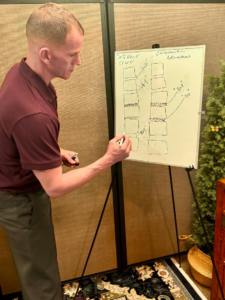
Dr. Joe demonstrates how self-cracking can create movement in a different area than the joint that is actually restricted.
Meanwhile, the restricted area can remain restricted.
This is one reason some people tell me they crack their neck several times throughout the day. It feels better temporarily, but before long they feel like they need to do it again.
In those cases, they may be repeatedly mobilizing an area that already moves well rather than addressing the underlying mechanical issue.
A Chiropractic Adjustment Is Specific
When I adjust someone’s neck, my goal isn’t simply to make it pop.
Before I adjust a patient, I evaluate how the spine is moving and determine where motion is restricted, what direction the joint needs to move, and whether an adjustment is appropriate and safe for that individual.
This evaluation can also help identify areas of spinal dysfunction, often referred to in chiropractic as subluxation.
Depending on the patient, that evaluation may include orthopedic testing, neurological examination, range-of-motion assessment, palpation, health history, and other examinations.
Then I can determine where and how to make a specific adjustment.
That’s very different from turning your own neck until you hear something crack.
There Is Also a Nervous-System Component
One of the things I wish more people understood about chiropractic is that the spine isn’t simply a stack of bones.
Your spinal joints contain an enormous amount of sensory information. Movement of those joints sends information to the brain and nervous system through mechanoreceptors and other sensory pathways.
So when I evaluate someone’s spine, I’m not thinking only about whether a vertebra moves.
I’m also thinking about the neurological input associated with that movement.
Whether you approach chiropractic from a philosophical or strictly neurological perspective, I think this is an important concept:
What you do to the spine affects the nervous system one way or another, either favorably or unfavorably.
My goal with an adjustment is to provide the appropriate mechanical and neurological input at the appropriate location.
Repeatedly forcing movement through an area that is already moving too much is very different from restoring motion to an area that is actually restricted.
Why This Matters for Active Coloradans
Living in Western Colorado, we ask a lot of our bodies.
My patients hike, mountain bike, ski, golf, work physical jobs, spend weekends on the Grand Mesa, explore the Colorado National Monument, work on their properties, chase kids around, and sometimes spend long hours sitting behind a desk or driving between all of those activities.
Grand Junction gives us incredible access to everything from hiking and biking to skiing, climbing, fishing, and paddling. Staying active is part of the lifestyle here.
But all that activity, combined with everyday work and repetitive postures, can also create areas of stiffness, compensation, and altered movement.
If your neck continually feels like it needs to be cracked, I don’t just want to know that it’s tight.
I want to know why.
Can Cracking Your Own Neck Be Dangerous?
This is where I think it’s important to keep things in perspective.
Serious complications associated with normal neck movement or spinal manipulation are exceedingly rare, but the cervical spine contains structures that deserve respect, including the spinal cord, nerve roots, and vertebral and carotid arteries.
Vascular injuries such as cervical artery dissection can sometimes occur spontaneously or following otherwise ordinary activities involving neck movement. Reported associations have included activities ranging from sports and prolonged neck positioning to salon shampoo positioning and cervical manipulation.
That’s one reason I examine patients before deciding whether and how to adjust their neck.
No examination can eliminate every conceivable risk. But evaluating neurological findings, vascular warning signs, trauma, instability, and other potential contraindications is very different from twisting your own neck simply because it feels tight.
Temporary Relief Isn’t Necessarily Correction
I won’t tell you that cracking your neck can’t feel good.
It can.
Joint movement can temporarily reduce muscle tension, change sensory input, and create a feeling of increased mobility.
But feeling better temporarily and addressing the reason a problem keeps returning aren’t necessarily the same thing.
In the same way, the absence of pain doesn’t necessarily mean that every area of the spine is moving and functioning optimally.
If you’re cracking your neck once in a while because it moves and happens to pop, that’s different from feeling compelled to crack the same area five, ten, or twenty times throughout the day.
When I hear that from a patient, the question I’m interested in is:
Why does that area continually feel like it needs to be cracked?
That’s what an examination can help us understand.
You Wouldn’t Perform Your Own Root Canal
Here’s an analogy I sometimes use.
Most of us wouldn’t attempt our own root canal simply because we know which tooth hurts.
Knowing where you feel discomfort doesn’t necessarily tell you what is causing it or how it should be treated.
The same principle applies to your spine.
Knowing that your neck feels tight doesn’t tell you which joint is restricted, which direction it needs to move, whether another joint is compensating for it, or whether manipulating the area is appropriate in the first place.
Chiropractors spend years studying anatomy, physiology, neurology, biomechanics, diagnosis, and adjusting techniques for a reason.
Specificity matters.
The Bottom Line
After years of treating patients, my answer to this question is pretty simple:
Cracking your own neck and receiving a chiropractic adjustment are not the same thing.
Cracking your own neck is usually a nonspecific movement performed until a joint cavitates.
A chiropractic adjustment should involve examination, clinical judgment, identification of dysfunctional biomechanics, and a specific intervention intended to improve joint function while considering the nervous system and the individual patient’s health.
So the next time your neck feels like it constantly needs to pop, instead of asking:
“How can I crack this?”
I’d encourage you to ask a different question:
“Why does it keep feeling like it needs to be cracked?”
That’s often the more important question.
Ready to Feel & Function at Your Highest Potential?
Whether you’re seeking relief from pain, looking to improve your mobility, or simply investing in your long-term health, my team and I are here to help.
At Mountain Valley Chiropractic, we offer personalized chiropractic care, massage therapy, and wellness solutions designed to help you move better, feel better, and live healthier.
Call us today at (970) 314-9244 for more information. We look forward to partnering with you on your journey to better health.
– Dr. Joe Heinecke